
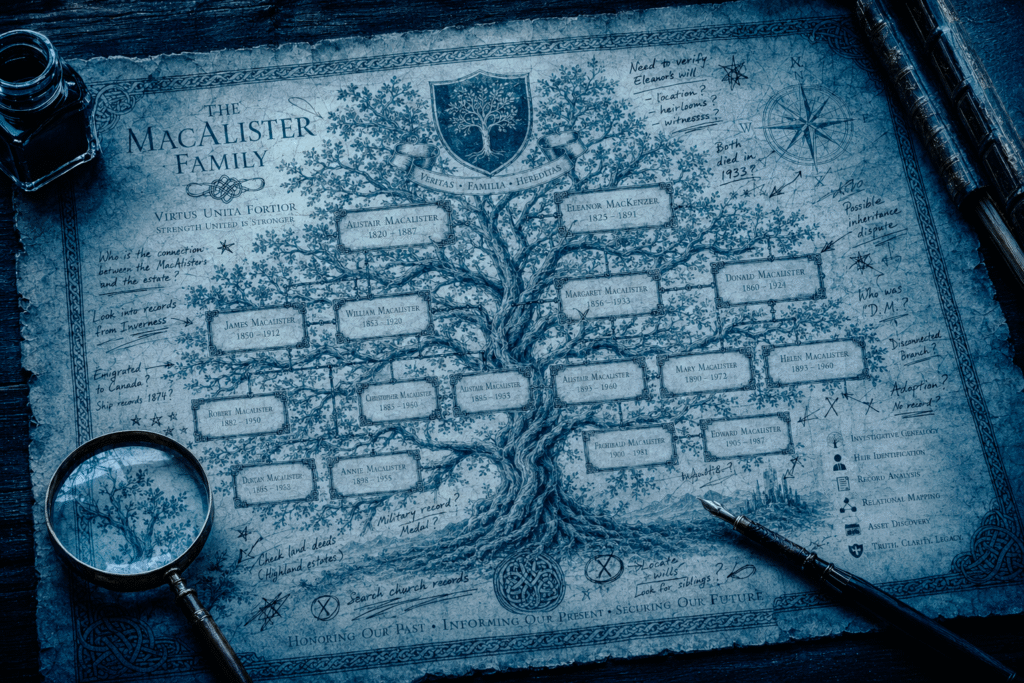
The administration of an estate is often viewed as a legal process centred on wills, probate applications, and the distribution of assets. In practice; however, many estate matters involve a far more complex challenge: determining who is entitled to inherit and ensuring that all beneficiaries have been properly identified and located.
When family relationships span multiple generations, jurisdictions, name changes, adoptions, remarriages, incomplete records, or estrangement, establishing heirship can become a significant investigative undertaking. In these circumstances, investigative genealogy and data analysis play an increasingly important role in supporting estate professionals, executors, trustees, and legal counsel.
At its core, heirship research is a data problem.
Every individual leaves behind a trail of information through public records, historical documents, vital statistics, property records, court filings, directories, census data, social media activity, news archives, and other sources. While each record may appear insignificant in isolation, together they form a network of relationships that can be analyzed, verified, and reconstructed.
Modern investigative genealogy combines traditional genealogical research with analytical methodologies more commonly associated with intelligence and investigative work. Rather than simply building a family tree, investigators assess the quality, reliability, and interconnectedness of information from multiple sources to establish relationships, identify gaps, and validate conclusions.
This analytical approach becomes particularly valuable when records are incomplete, contradictory, or dispersed across multiple jurisdictions. A surname appearing in one jurisdiction may be linked to descendants in another. A historical address may reveal family connections that are not apparent through vital statistics alone. A single obituary may identify previously unknown relatives whose existence alters the distribution of an estate. By examining relationships rather than isolated records, investigators can identify patterns and connections that might otherwise remain undiscovered.
Data analysis also assists in prioritizing investigative efforts. Large family trees can contain hundreds of individuals spanning multiple generations. Analytical tools allow researchers to map relationships, identify likely descendant branches, assess the probability of living heirs, and focus resources on the most relevant lines of inquiry. This process reduces duplication of effort and helps accelerate estate resolution.
Verification is equally important. Establishing a family relationship is only one component of heirship research. Information must be corroborated through independent sources to ensure conclusions are accurate and defensible. Multiple records are often compared and cross-referenced to confirm identity, lineage, marital history, mortality status, and potential beneficiary entitlement. This layered approach helps reduce the risk of errors that could affect estate administration or result in future disputes.
The increasing availability of digital records and open-source intelligence has further expanded the investigative toolkit available to heir researchers. Publicly available online information can provide valuable context regarding identity, location, family connections, and life status. When integrated with traditional genealogical research, these sources help create a more complete and current understanding of familial relationships.
For estate professionals, the benefit is not simply locating missing heirs. It is obtaining a comprehensive and defensible understanding of the family structure surrounding an estate. Whether the objective is confirming entitlement, identifying unknown beneficiaries, validating lineage, locating descendants, or resolving uncertainties within a family history, data-driven investigative genealogy provides a structured framework for transforming fragmented information into actionable intelligence.
As estates become increasingly complex and families become more geographically dispersed, the ability to analyze relationships, verify identities, and reconstruct family networks has become an essential component of modern estate administration. The combination of investigative methodology, genealogical research, and data analysis offers a practical, defensible means of bringing clarity to matters where uncertainty may otherwise delay resolution.