
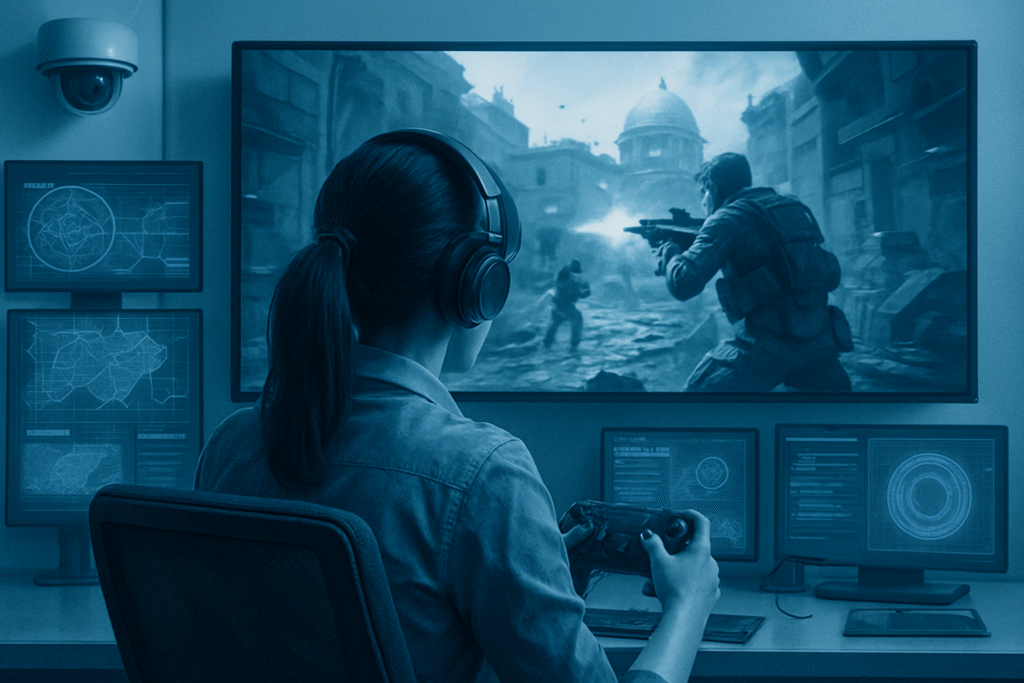
Open-Source Intelligence (OSINT) investigators and data analysts work in environments that demand rapid processing, exceptional attention to detail, cognitive endurance, and adaptive decision-making. In an unexpected but growing body of research, high-paced video games—particularly action-oriented titles—have demonstrated measurable benefits to the very cognitive faculties required for high-performance OSINT work.
A study by the National Institutes of Health (NIH) found that people who played video games for three or more hours a day outperformed non-gamers on tasks involving impulse control and working memory. Functional MRI scans indicated heightened activity in brain regions associated with attention and memory. For OSINT professionals, who must simultaneously manage information intake, filtering, and pattern recognition across a sea of digital noise, these enhanced capabilities are crucial.
(source: https://www.nih.gov/news-events/news-releases/video-gaming-may-be-associated-better-cognitive-performance-children)
Further supporting this link, research published in *Neuron* concluded that action video game play strengthens attentional control. This improvement directly supports the daily functions of OSINT investigators, who need to sustain focus while navigating multiple data streams, open tabs, social media threads, and geolocation tools—all in real time.
(source: https://www.sciencedirect.com/science/article/pii/S0896627319308335)
Moreover, a comprehensive meta-analysis in *Psychological Bulletin* confirmed that action video games improve spatial cognition, multitasking, and mental flexibility. These are core competencies for analysts working across geospatial platforms, metadata timelines, and structured/unstructured datasets to detect anomalies, extract insights, and trace digital behaviors.
(source: https://tmb.apaopen.org/pub/qj0c4ij2)
In short, the skill set cultivated by fast-paced video games—focused attention, mental acuity, cognitive endurance, adaptive switching, and decision-making under pressure—mirrors the demands placed on OSINT analysts and investigative professionals. For organizations committed to continuous development and cognitive training, video game-based exercises may represent a modern and engaging way to build high-performing digital intelligence teams.