Look before you leap: Safeguarding your investment
An investment promising exceptional returns can be difficult to resist, especially when it is supported by a convincing pitch and a professional-looking website. But appearances can be deceiving, and once your money is gone, recovery may never be possible. Learn how professional due diligence can uncover warning signs, verify the people behind an opportunity and help you make an informed decision before you commit.
Ghosts in the rain. Signals in the cloud.
Investigative work has changed dramatically, but its purpose hasn’t. From rain-soaked surveillance and paper records to OSINT, metadata, and digital intelligence, Ghosts in the Rain, Signals in the Cloud explores two eras of investigation—and the enduring principles that connect them.
Better investigations start with a conversation
The most valuable part of an investigation often happens before the work begins. A conversation at the outset can clarify goals, identify limitations, uncover overlooked options and prevent actions that could compromise the outcome. Whether the concern involves an insurance claim, workplace misconduct or a business dispute, understanding the situation before acting helps protect evidence and direct resources effectively.
Turning the tide on cooking oil theft: How data analysis identified and stopped a costly loss
A food-waste refiner was losing thousands of litres of used cooking oil each month. Drivers arrived at restaurant bins only to find them empty, and growing financial losses threatened the company’s operations. An initial theory pointed to a rival competitor’s crews siphoning the grease, so our team coordinated surveillance on that competitor. After several nights without incident, it was clear they were not involved and we needed a new approach.
Shrinkage is a symptom, not the cause
Your inventory keeps disappearing. At what point does shrinkage become an investigation? Any time. Every unexplained loss points to a weakness that employees or members of the public may learn to exploit repeatedly. Identifying where, how and why inventory is disappearing allows the business to correct the root cause before a small loss becomes a much larger problem.
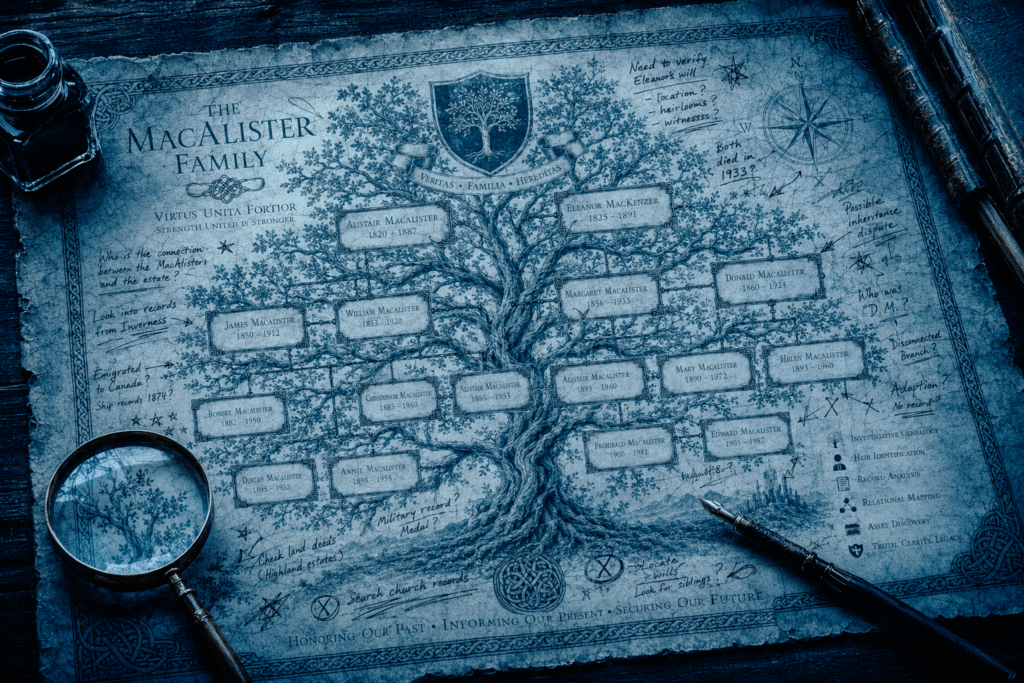
Investigative genealogy. Heir location. Estate settlements. Peace of mind.
The administration of an estate is often viewed as a legal process centred on wills, probate applications, and the distribution of assets. In practice, however, many estate matters involve a far more complex challenge: determining who is entitled to inherit and ensuring that all beneficiaries have been properly identified and located. Modern investigative genealogy combines traditional genealogical research with analytical methodologies more commonly associated with intelligence and investigative work.
Data in plain sight: What the hidden patterns of daily life can tell us
Data is all around us, hidden in plain sight. Its the patterns of life which, when taken in context and overtime, offers a glimpse into untapped resources. It’s in the car that no longer leaves at 7:30, the colleague who suddenly stops copying leadership, the vendor who changes tone before missing a deadline. These are not random moments; they’re cues. Missed patterns become missed signals. And missed signals become missed opportunities. The information is there, moving quietly around us. The advantage lies in noticing what others overlook.
The cognitive divide: Why effort is not the same as insight
In professional investigations, activity is often mistaken for progress. Information is gathered, interviews are conducted, records are pulled, searches are run. All of the boxes are ticked off. Yet none of this, on its own, guarantees understanding. There is a material distinction between exposure to information and the disciplined analysis required to extract meaning from it. Without these elements, investigations risk becoming compilations rather than conclusions.
The myth vs. reality of OSINT
OSINT is widely mistaken for simple online searching, but true intelligence work extends far beyond a search bar. Real OSINT blends advanced online analysis with offline public records, interpreting behaviour, patterns, and documented facts to reveal what surface searches miss. It requires a disciplined mindset, an understanding of the investigative environment, and the experience to recognize where meaningful information actually lives. OSINT isn’t about looking harder. It’s about looking smarter, deeper, and with clear investigative purpose.
Winning by numbers: How data analytics is changing the game
Traditional investigation has always been activity-based: who went where, when, with whom, and what did they do. This method focuses on tracking movements and actions to reconstruct events, a process rooted in observation and physical evidence rather than digital insight. That focus is rapidly evolving into a data-driven discipline. Just as investigators now uncover patterns hidden within vast datasets, professional sports teams are harnessing the same analytical power to decode performance, predict outcomes, and gain a strategic edge over their competition.
The lights are on but is anyone home: The case for smarter security audits
We often assume that visibility equals security. If the lights are on and the cameras are rolling, we believe everything is under control. But behind every floodlit loading dock and password-protected server is a deeper question: Is anyone really watching—and do they know what they’re looking for?
The eyes have it: Everyday surveillance and the digital witness revolution
In today’s hyper-documented world, surveillance isn’t just the domain of law enforcement or “Big Brother.” It’s the teenager livestreaming a protest, the commuter filming an automobile crash, the tourist capturing a moment that becomes history, and the concerned citizen recording a police arrest to ensure accountability. Every smartphone lens, store camera, and social media upload has become part of a vast, unblinking network of observation.
Heirs, history, and healing: The investigative search for family, facts, and finality
Investigative genealogy offers more than just names on a chart—it helps people reclaim lost identities, resolve legal and personal questions, and reconnect with their roots. This work brings emotional healing, preserves generational knowledge, and provides clarity where history, memory, or circumstance has left gaps. It combines traditional genealogical methods with investigative techniques to verify identities, trace lineages, locate heirs, and solve complex family-related inquiries.
Using the right resources
"If your only tool is a hammer, then every problem looks like a nail." This is a cognitive bias that involves an over-reliance on a particular tool because it was immediately available or familiar. The desire to do the right thing is often overshadowed by the need to do things quickly, cost-effectively and easily. However, knowing your limitations and recognizing that others have abilities in areas you lack while having access to a wide range of experts ensures the best possible outcome.
From fractures to failures: What the Broken Windows Theory reveals about workplace risk
In 1982, a theory was introduced that would go on to reshape modern crime prevention. Known as the Broken Windows Theory, it proposed a bold idea: that small signs of neglect—like a single shattered window—can invite much larger problems if left unaddressed. The same principle holds true within the walls of our workplaces, where minor, unchecked infractions often evolve into major threats—eroding safety, culture, and trust.