October 1980:
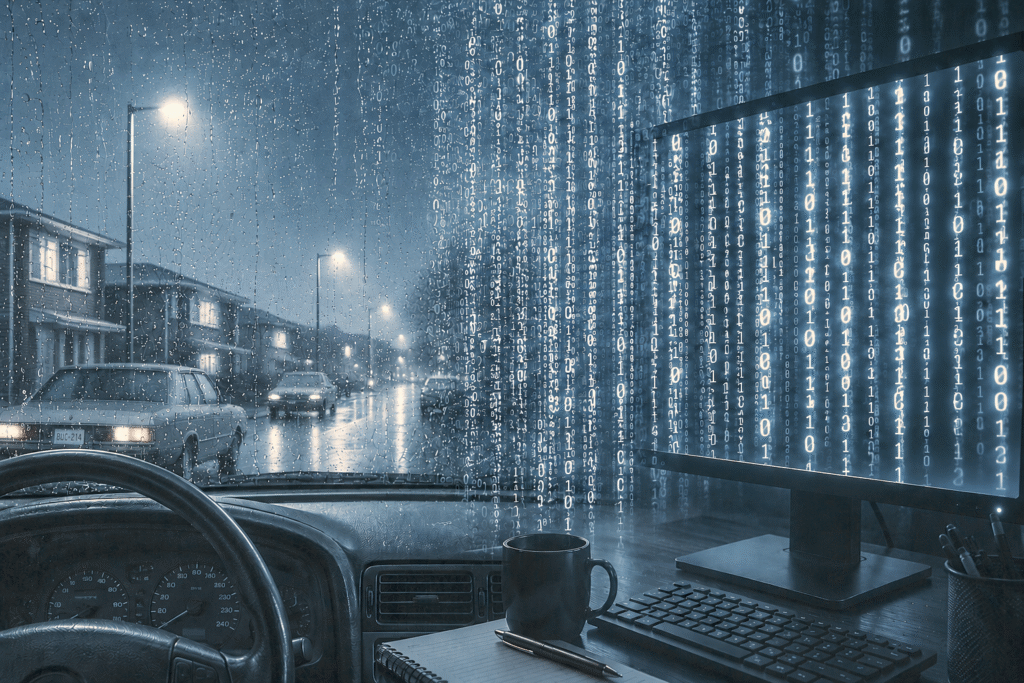
Rain stitched crooked lines down the windshield, like snakes trying to escape the weather. It was the kind of cold October drizzle that worked its way under the collar into your bones no matter how tightly you buttoned up. He’d been parked on this quiet suburban curb since half past five, engine off to avoid suspicion, breath fogging in the air like puffs of cigarette smoke; a ghost in a sleeping neighbourhood, clinging to the old saying that early birds catch the worms though today, he suspected the worms knew better.
Light filtered in from a nearby lamppost, adding just enough light to barely see his remote office for the day. On the passenger seat lay his map book. Creased, softened, and already starting to warp from the damp air inside the car. He smoothed it open for the tenth time, making sure the subject’s address sat at the centre. A red circle marked the house. Pencil lines branched toward the tile factory where the subject worked and a small gym tucked between a newsagent and a laundromat. These were best guesses built from discrete inquiries with his employer and neighbours, and a bit of legwork.
The SLR camera rested beside the map, loaded with 36 exposures. Every shot would have to count; there was no preview screen, no second chance if the shutter stuck or the focus slipped. Of course, taking photos through rain-soaked windows presented its own challenges. He checked the settings again out of habit: aperture for low light conditions, shutter speed, manual focus set roughly to the distance of the subject’s driveway.
In the footwell sat his notebook, waiting for the first entry of the day. No dictation apps. No auto-timestamping. Just a pen, a ruler, and lines he’d fill the moment something happened. If it happened. That notebook was more than a log. It was the record. Activities were borne from it. Leads were built from it. Statements were tested against it. Cases rose or collapsed on the strength of those entries. If it wasn’t written there, in ink and in sequence, it might as well have never happened.
His two-way radio crackled occasionally with static, but that was expected. Coverage wasn’t reliable in this part of town, and if the signal dropped entirely, there wasn’t much to do except manage alone until it came back. Most of that was moot as there was no one else on the other end, not yet. He kept it on just to add some life to a lifeless and sleepy world laid out around him.
He lifted the thermos lid, took a sip, and watched the house. Surveillance was mostly this – long quiet hours, confirming routines, waiting for the smallest sign of movement. The work could be rewarding but wasn’t glamorous. It required patience, consistency, and the willingness to sit in a cold car for as long as the job demanded.
He’d spent most of the previous day doing what investigators did long before databases and search engines: chasing paper trails. The first stop had been the public library. He pulled phone books from the shelves – some new, some years out of date – and flipped through them one by one, checking for the subject’s surname, then given name, then any variations he could think of. If he didn’t find a listing under the current address, he checked the previous year, then the one before that. He knew from experience that people were creatures of habit. The way someone first listed their name in the phone book was the way they carried themselves everywhere else, no matter how many times they moved. The details changed – towns, jobs, addresses – but the way they presented their identity rarely did.
Next came the cross-reference directory – those thick, unwieldy criss-cross books organized by street name or phone number instead of surname. He traced each row with his finger, confirming numbers, occupants, and the odd notes written in small print by the publisher: “moved,” “vacant,” “business,” “unlisted.” If a spouse or roommate was noted, he added their name to the margin of his notebook. It was slow, methodical work – page after page, cross-checking names against streets, then streets against numbers, hoping the pieces lined up. It was hard work, but this was an investigator’s treasure chest.
When the library assistant unlocked the cabinet drawers, he pulled the microfiche film, placed them under the reader, and scrolled slowly through municipal property assessments. The soft whir of the machine filled the room. Most of the records were at least a year old by the time they made it to microfiche, but it was better than guessing. He located the parcel number, confirmed ownership, and wrote down the legal description, even if the subject was just a tenant. If he had time, he’d look up local newspapers, just in case.
After lunch, he stopped at the municipal clerk’s office. It wasn’t unusual for a clerk to look mildly puzzled when someone asked for building permits or occupancy records – they were public documents but rarely requested. He signed a ledger, waited his turn, and reviewed whatever the clerk placed in front of him: renovation permits, change-of-use notices, even complaints logged by former neighbours. Every detail felt like progress, even when most of it led nowhere.
The next hour was spent driving the area. Not surveillance – just familiarization. He noted the layout of the street, the footprint of the subject’s residence, the parking patterns, the blind corners, the routes in and out of the area, the direction the sun would rise behind the houses. He checked the view from a side street, then from the small parking lot near the church. It helped him plan for the morning ahead.
On the way home he stopped at a corner shop, bought a newspaper, and asked the owner offhandedly if he knew the family living at the subject’s address. Casual questions, nothing heavy-handed. Sometimes he got answers. Sometimes he got shrugs. That was the nature of it.
Finally, he phoned a contact from a payphone outside a gas station, a retired mailman who remembered whole neighbourhoods by memory. They talked for fifteen minutes about who used to live at the house, whether kids ever played in the yard, and whether the current tenant kept to himself. It wasn’t formal intelligence, but it was the kind that helped shape expectations.
By the time he’d compiled everything, he had a clearer picture but not a complete one. There were always gaps in 1980. No instant verification. No database cross-checks. Just persistence, paper records, the process of elimination. “When you have eliminated the impossible, whatever remains, however improbable, must be the truth,” as Sherlock liked to say – until the last surviving detail finally pointed in a direction he could trust. It was living on a wing and a prayer that you had the right house and, if someone came out, you’d follow the right person.
Present Day:
By half five in the morning, the office was quiet enough that he could hear the low hum of the server rack behind him. His father would have been huddled in his car at this hour, watching a dark window for signs of life. He, on the other hand, didn’t need the rain or the cold, the map book, or the thermos. His workday began with a login prompt.
He opened the case dashboard and pulled up the subject’s identifiers. No need for phone books or microfiche; a quick pivot from a username to an email address gave him the subject’s entire constellation of online accounts – some active, some abandoned, all useful. Within minutes he knew far more than any amount of pre-planning or morning of physical surveillance could reveal.
Social media added its own layer. A post buried lower on the timeline – a photo of a brace on the subject’s right leg, uploaded shortly after a cycling accident. The comments offered wishes of a “speedy recovery,” along with a timeline suggesting reduced mobility and limited travel.
Even more telling was a public post on the spouse’s Instagram account from a week earlier showed the subject standing beside a rental car in Portugal, sunburned and smiling, captioned: “Long overdue break. Two more weeks!” The image metadata still included the geotag, a small oversight on the user’s part but a gift to anyone who knew where to look. He noticed that the brace and crutches the subject usually uses were nowhere to be seen, suggesting the subject might not be as injured as he let on.
A press release by the subject’s employer indicated that they were switching to a remote work-from-home model. Photos posted by the subject and matched against time-of-day indicators such as the length and direction of shadows, confirmed a steady pattern of working from home. That alone would’ve saved his father hours of sitting on empty streets waiting for movement that would never come.
A post on his Facebook timeline indicated he was looking forward to an upcoming concert, a golden opportunity for surveillance. Other posts hinted at a woodworking business the subject was growing out of his garage. Cross-referencing his LinkedIn activity and online comments clarified the picture: the subject wasn’t just away; he had been alternately recovering, sheltering in place, travelling, working remotely, and adjusting his routine. No physical surveillance car could have caught that.
He opened a relational-mapping tool and populated the network: tagged friends, co-workers, people who commented frequently, accounts with identical profile photos but different usernames. His father’s information would have been built from interviews and payphone calls. This was built from digital exhaust the subject left without thinking. He paused, leaning back in his chair.
His father used to describe the job as “long periods of nothing, waiting for something” or, depending on his audience, “the job was 99% boredom and 1% sheer panic.” Now the “something” often appeared immediately, before sunrise, served through API calls and cached archives. It was still the thrill of the hunt, the burst of adrenaline, piecing together the pieces of the puzzle but in an entirely new way.
He smiled at that. Different era. Same work. Just a new way of following the trail.
Where his father had spent a day flipping paper records, he pulled up the same details with a few strategic pivots: property records scraped from a public registry, vehicle details, street and satellite views, and neighbourhood data pulled from a local forum long since abandoned.
He didn’t need to sit outside the house to confirm if someone else lived there. Their names appeared in friends lists, tag posts, and holiday photos showing the same front garden from different angles.
Everything physical surveillance hoped to infer, modern OSINT could often verify – or disprove – in minutes. Where his father would manually connect phone numbers to addresses to individuals, the modern investigator follows the trail of digital breadcrumbs.
He updated the details in his case management software and took a sip of reheated coffee. His father would have called this cheating or at least bending the game. He leaned back to look at the old map book he kept on the shelf behind him, his father’s handwriting still faintly visible on the creased pages. A reminder of how investigations used to begin. But the work was the same in principle: find out where people go, what they do, who they’re with, and what their lives actually look like below the surface.
Today, his tools were different. But the pursuit was the same. And the truth, as ever, leaves a trail – just a far more digital one now.
Closing: Two Eras, One Craft
For all the distance between 1980 and today, the work itself hasn’t really changed. What anchored the job then still anchors it now: Observe what’s real. Record what matters. Validate everything.
The man in the cold car with a map book and a thermos, and the son in the glow of a multi-monitor workspace, are doing versions of the same thing. One traced paper records with a fingertip; the other follows digital breadcrumbs through databases and social media feeds. Different tools, same purpose. Surveillance will always be a part of the process but, with the added intelligence of digital indicators, the work can be scheduled to maximize efficiency, explain gaps and be in the right place at the right time.
The father did it with film, ruled lines, and the patience to sit in the rain until something –anything – shifted. The son does it through metadata, pivot points, and patterns that surface long before the subject’s house lights ever come on. But both rely on the same instincts: watch closely, question constantly, never assume you have the full picture until you prove you do. Even then, know that you can’t know it all.
Technology widened the lens – literally and figuratively – not the principles. It has expanded our reach, accelerated our access, and sharpened our tools – but it has not altered the essence of the craft. Sometimes the most accurate picture comes from a combination of both disciplines, where traditional observation and modern OSINT reinforce each other. The craft is still built on small details, careful confirmation, and the quiet discipline of following a trail wherever it starts to wherever it leads, notice what others overlook, verify what others assume, and follow the thread with patience and precision – whether that trail is a faded phone-book listing or an overlooked GPS coordinate in a holiday photo.
Two investigators. Two eras. One continuous standard.
The work has evolved. The tools have changed. The mission did not. Progress demands that we grow with the times – adopting new tools, new platforms, and new ways of seeing – but true investigative strength comes from the enduring foundation of discipline, verification, and principled inquiry that always has, and always will, define the craft.
Originally published in the May/June 2026 issue of PI Magazine.